

Spaniards head to the polls on Sunday in what is the most unpredictable vote since the country emerged from dictatorship into a fragile, newborn democracy more than 40 years ago.
It may sound like a lazy, simplistic exaggeration. But in this election, the battle is about the very unity of Spain.
The Socialists are set for a decisive victory under current Prime Minister Pedro Sánchez, brought to power only 10 months ago.
All polls show he’ll be well short of a majority. After that all other bets are off.
So Sunday’s election will be more about who will pact with who the day after. The coalition talks that follow will be long and messy.
They’re completely unknown territory for Spain. Spanish news bulletins are buzzing with speculation about what the next government will look like. No-one knows for sure.
The country has never had a governing coalition at national level in modern times.
On the campaign trail, the left and the right have used it as threat, saying their political adversaries in a coalition would put Spain into a state of chaos.
It would mean either a centre-left government between the Socialists and the far-left party Podemos, with its more sympathetic approach to Catalan parties who want to break apart Spain.
Or a centre-right alliance that would swing Spain nearer to the extreme right.
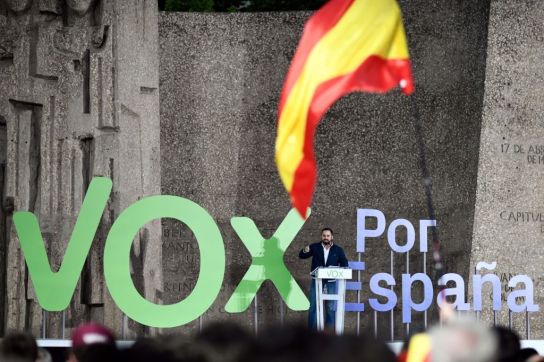
The unpredictable factor comes from the staggering rise of the far-right Vox party. In the 2016 election, they won just 0.2% of the vote. This time round, they could be the kingmakers.
Its policies are straight from the populist playbook. As well as being both anti-immigration and anti-establishment, its main focus is defending national unity, promoting Spanish values and traditions and proudly waving the Spanish flag as a nationalist symbol.
For some, this is a nightmare scenario. For others, the status quo under the current Prime Minister is to be feared more.
“If Sánchez wins, Spain will stop being what it’s been the past four decades”, centre-right Popular Party leader Pablo Casado said in a TV debate this week.
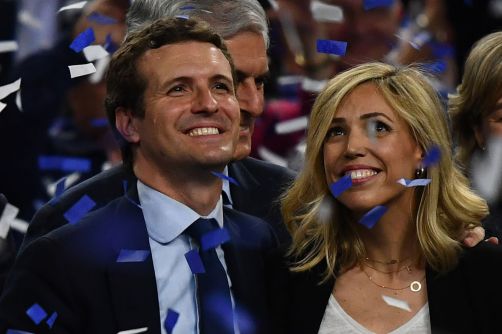
The 38-year-old, photogenic leader of the PP was elected leader last summer, bringing in a more right-wing agenda than his predecessor, Mariano Rajoy.
His party has been forced to move to the right precisely because of the threat of Vox. But it could be a poor strategy. The PP are currently on course to half their number of seats.
Casado’s message to voters is that Spain needs to be rescued from pro-Catalan independence parties that are threatening national unity and holding the country hostage.
Some voters perceive that former leader and Prime Minister Mariano Rajoy wasn’t tough enough on Catalonia.
During Rajoy’s time in office, relations between Spanish and Catalan leaders had been bitter for years. Sánchez has managed to turn down the heat, resuming dialogue and forming a working group.
But in doing so, the opposition has accused him of being both a traitor and danger to Spain.
Sánchez has retaliated, refusing any discussions about independence or a referendum.
Elections had always seemed inevitable.
With a weak government and a far less-than-finished set of reforms, he had no option but to call snap elections back in February.
The straw that broke the camel’s back was Spain’s delayed budget.
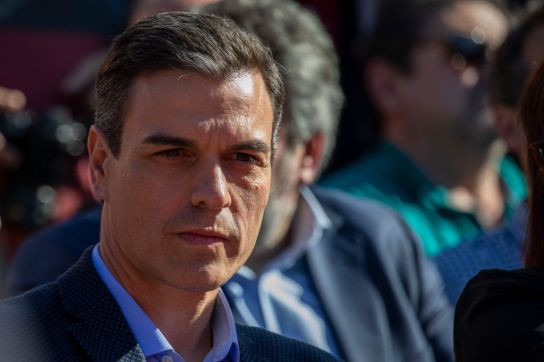
It’s the irony of Spanish politics that Mr Sánchez was brought to power by Catalan independence parties – who could be behind his potential, if unlikely, downfall. The same parties then voted down the budget, rejecting conditions for talks between Madrid and Barcelona.
To have got even this far, Sánchez has had a certain amount of luck. He was in the right place at the right time when he became the first Spanish politician in modern times to win a confidence vote, signing agreements with a broad range of parties to bring down Rajoy and his party’s long legacy of corruption.
As Sánchez saw it, his government, with its majority-female cabinet, would be a symbol of a progressive Spain that wants to be the centre of European affairs. With his polished, youthful image, it was straight out of the Macron playbook of politics.
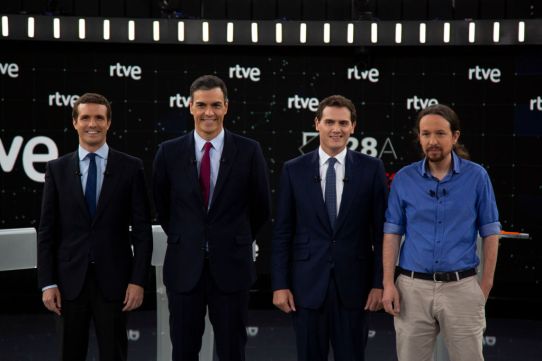
Earlier this week, the four male candidates for Spanish Prime Minister took part in two consecutive nights of late-night TV debates, ending in typical Spanish style well past midnight, before being chewed over even more in post-match analysis.
The elephant in the room all along was Vox.
To coin a phrase, it is on a self-styled conquest to ‘make Spain great again’.
In its view, that means standing against progressive reforms, feminist policies and laws protecting women from domestic violence.
Vox is competing to be the toughest on Catalonia, tapping into anger across Spain after the region’s illegal independence referendum in 2017.
The party supports returning power to Madrid, bringing back echoes of the centrist totalitarianism that Spain lived through under Franco.
Formed back in 2013, it’s taken a while for the party to gain traction. It was catapulted to the national stage only in December, after standing in regional elections in Andalucía.
It won 12 seats and 11% of the vote there, bringing down near 40 years of Socialist rule and becoming the first far-right party in a regional parliament since the Franco era.
In Sunday’s election, Vox is expected to enter Spain’s parliament for the first time with around 30 seats. However, polls could be underplaying the party’s popularity. A ‘hidden’ vote could propel it above fifth place and give them twice as many seats.
Even after this election, Vox will still be a fringe party, but as all populist parties do, they have great influence on their establishment counterparts, which in turn mimic some policy to avoid haemorrhaging votes.
As such, this is already victory for Vox.
Many of its founding members were disaffected Popular Party members.
The party is expected to fare similarly to Podemos, the far-left populist party born at the same time as the protest movement over inequality and Spain’s ailing economy.
Its leader, Pablo Iglesias, is unforgettable. A former university professor, he has a ponytail, rolled-up shirt sleeves and a constantly raised fist in defiance of the political mainstream.
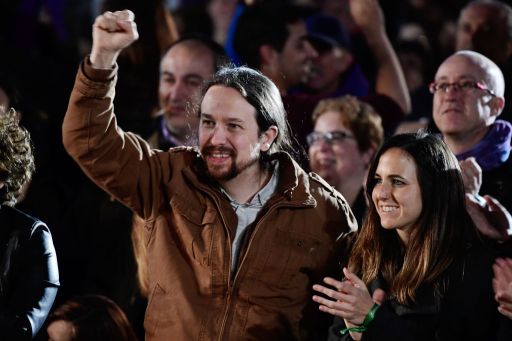
To get a measure of their politics, Podemos endorsed Jeremy Corbyn’s campaign to lead the Labour party in 2015.
Iglesias is looking incredibly likely to support the Sánchez and his PSOE party to keep the centre-left in power. Mr Sánchez sounds warm about the idea of offering them ministries in government and analysts suggest it is the most likely outcome.
Together, they hope they will see off the Popular Party and the signs they will form a centre-right coalition with Vox and Ciudadanos, another party that has been pulled to the right from the centre ground.
Like Vox, Ciudadanos stands firm on Catalonia, where the party was born.
It has its eyes on taking over the Popular Party as the largest centre-right party and has ruled out entering a coalition.
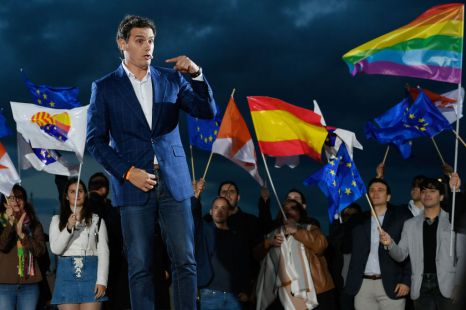
Its leader Albert Rivera, said it was a “national emergency” to get rid of Sánchez.
If Sánchez and the Socialists manage to emerge as the largest party, it will be their first victory in more than a decade.
It will be a show that, against the rules of politics these days, occupying the centre-ground is a vote-winner.
But that won’t be enough.
As we know all too well, polls these days throw up all sorts of surprises.
Vox’s vote could be underestimated, the right could rise, the left could be revived – or the biggest surprise at all, that there is no surprise.
Across Europe, the political establishment is continuing to be rocked. Two-party politics is over and fragmentation rules.
Spain was always the country that most thought would be immune from populist, far-right politics, especially given its still raw fascist past.
That prediction was wrong. Now, Spain is in for a few volatile months.
 Andrew Connell