A false start for France’s presidential election

A false start for France’s presidential election

The battle lines are drawn in a hotly contested presidential election – that’s a year and a half away.

How far France swings to the centre-right or the extreme right will be the big headline when the country goes to the polls in spring 2017.

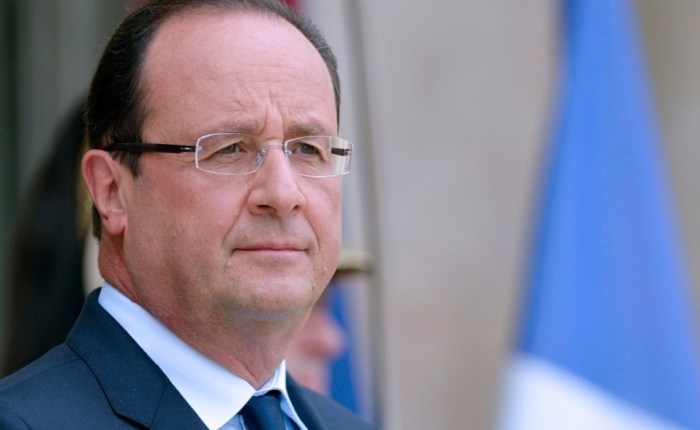
The second – how big the defeat for France’s most unpopular president, François Hollande. He can do little more than survive the political storm to come, as the economy stutters along. However, there are encouraging signs from business and confidence as the effects of controversial reforms start to bear fruit.

That’s not to forget important elections this December in France’s regions which are the last test for parties before the country elects a new President. Campaigning is already in full force.

President Hollande addressing the European Parliament in Strasbourg on Wednesday.

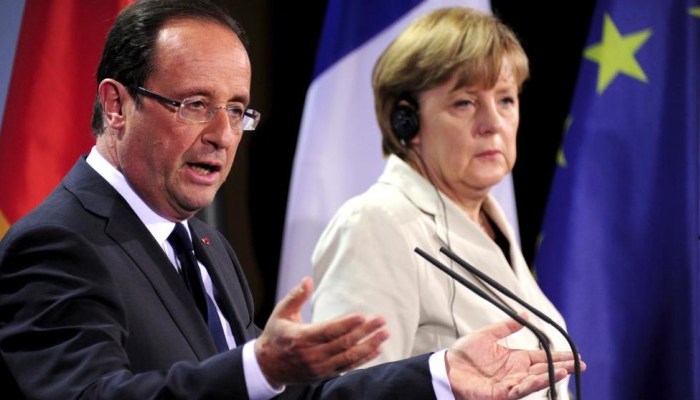
On Wednesday, Front National leader Marine Le Pen stood up in the European Parliament in Strasbourg in front of Hollande and German Chancellor Angela Merkel, armed with a double blow.

Hollande and Merkel in turn addressed a room full of Euro MPs, calling for more Europe at a time when the continent is more divided than ever over the influx of migrants and refugees. It was a speech that many deemed lacklustre. For Ms Le Pen, it provided her a platform to deliver some memorable, hardhitting soundbites. She was on a roll in her three-minute address.

Le Pen called Hollande Germany’s “vice-chancellor” who had sold out to a Berlin-dominated Europe. And to Mrs Merkel, she said: “I don’t recognise you, Madam.”

Hollande mustered some steel, saying the EU was a bastion against the “return of nationalism, populism [and] extremism”.

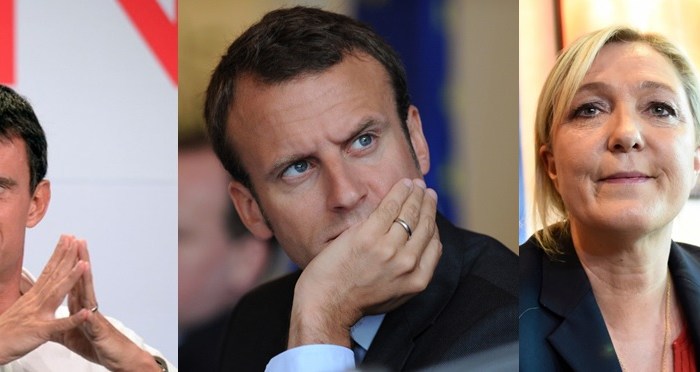
French Prime Minister Manuel Valls characterised the situation with the FN as “worrying”. From the opinion polls to the division in the party and the left of politics, Valls recognises the more-than-credible threat from the rise of Le Pen – he is not alone.

Sarkozy's ally, Nadine Morano, who called France
Sarkozy’s ally, Nadine Morano, who called France “a country of the white race”

Nicolas Sarkozy has himself been embroiled in an internal affair this week which threatens the Republican party’s image just a few months since its rebrand. One deputy, Nadine Morano, has been pulled as a candidate from December’s regional elections after calling France “a country of the white race”. Only a few days later did Mr Sarkozy see the comments of one of his most loyal allies unacceptable. It is a huge deal for the party seized upon by their opponents.

Sarkozy is all too aware of the battle with the Front National. It is a tricky balancing act to appeal to FN voters and at the same time not lose moderate support in the important centre ground. One pollster said: “People prefer the original to the copy.” Sarkozy runs the risk of overstepping the line by putting FN sentiment into the political mainstream by simply legitimising them. No such threat from Mr Hollande, whose days, Sarkozy said, were numbered.

There’s no topic more divisive than that of immigration, despite the country’s insecure economic footing as Europe’s second-largest. The FN’s anti-immigration stance is one which is likely to see them win in the north of the country as well as its traditional stronghold in the south-east at the least.
Air France executive rescued by security
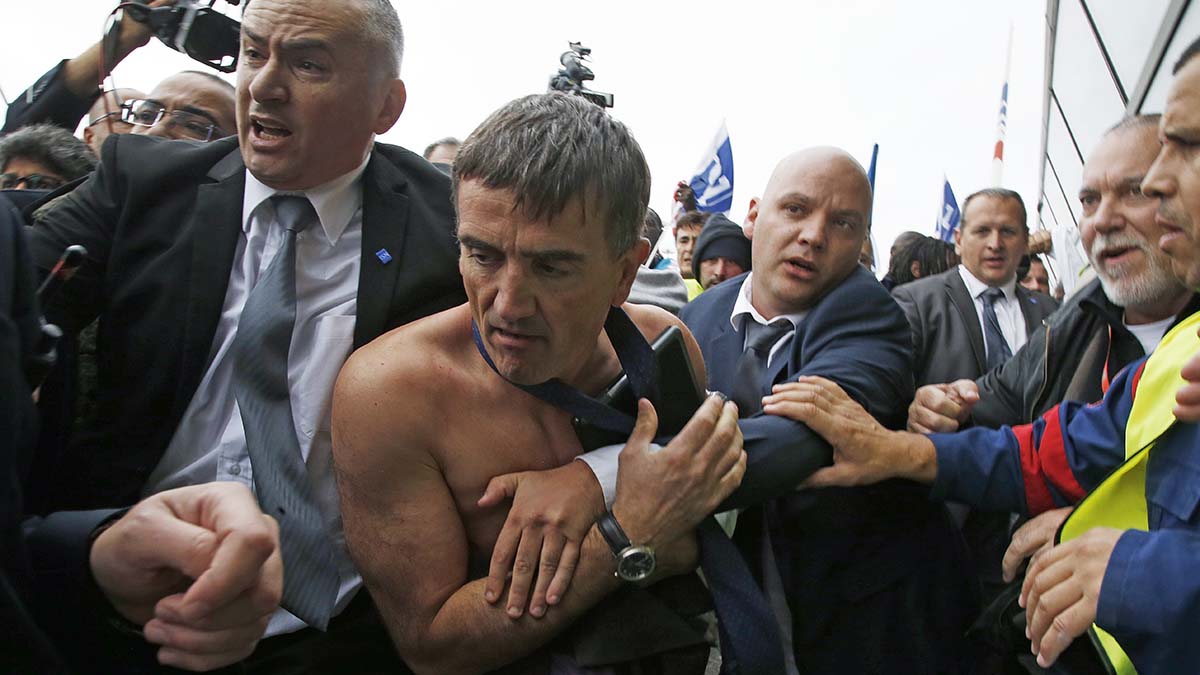
Air France executive rescued by security in a violent protest in Paris

It is also a week which saw scenes of violent protests at Air France in Paris over 3,000 jobs lost plastered across international newspapers and TV screens. An shameful reminder of the French stereotype of going out on strike which turned ugly. Hollande said such images had “serious consequences” for the image of France. For critics, it served as an opportunity to point to France’s footdragging on reforms. A large section of French business has long grown inefficient and uncompetitive. They’re only starting to realise that they have some way to go to regain lost ground in the global economy.

This electoral rollercoaster ride shows the damage of untimely blunders in the unforgiving political arena. In the words of Nicolas Sarkozy, it is a fight to the death.

More: Air France turbulence may end in crash, The Independent
France’s unpredictable political machine fires up once more

France’s unpredictable political machine fires up once more

The French political machine is powering up again after a summer break, greatly in anticipation of December’s regional elections. This week, loyalists and members of France’s governing Socialist party, along with those from the Front National, have been gathering to muse party strategy and reflect on policy in the annual ‘université d’été’ conference season amid a stagnant economy and a large programme of reforms aimed at cutting down France’s large bureaucracy.

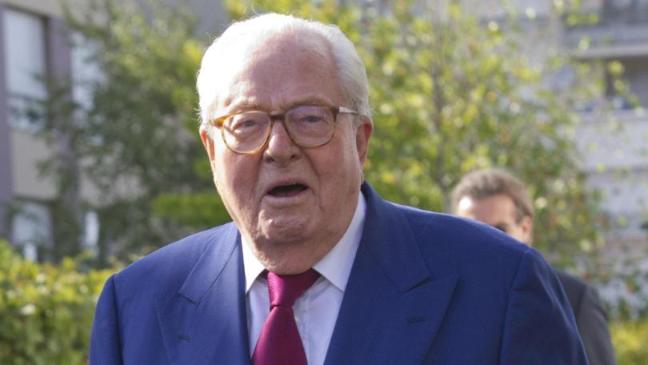
If last week was dominated by fall-out from the parricide of Front National co-founder Jean-Marie Le Pen, this week’s big story was a proverbial call to arms to rescue the flagging Socialist ship, together with the internal row within the government over the country’s sacred 35-hour working week.

Prime Minister Manuel Valls brought the party gathering to a close with a speech centred on the values of the Socialists, calling for members to be “proud”. So passionate was his hour-long address that his shirt was visibly soaked through with sweat. Among his pledges was the duty to help those fleeing war, torture, oppression and persecution, who “need” France’s help and “must” be welcomed.

On the 35-hour working week law, the holy cow of the French left, Valls considered the issue “clos”, or closed, after a series of heated public disagreements with rogue Economy Minister Emmanuel Macron. He argued it was a “false idea” for France to think it would create more jobs and grow more if people worked fewer hours, especially in comparison with other European nations, such as Britain or Italy. Favouring abstract language, Valls asserted: “What interests me is not the past but the future.”

Absent from the weekend conference, young members of the Socialists called for Macron’s resignation, booing at the mention of his name or allusion to his economic plan.

Macron, a former banker, has thus far divided political minds. For the traditionalist wing of the Socialist party, he is part of the elite, guilty of straying from traditional Socialist values, as Hollande positions himself as increasingly pro-business, after a purge of left-wing members from his cabinet last summer. Supporters say Macron is forcing France to face an inconvenient truth and, as such, adopt necessary reforms.

The minister said work should be a “central value of the left”, not a “taboo subject”.

Reforms for France’s flat economy are the order of the day as the unpopular government seeks to be seen as economically credible. Defiant as ever, Valls said: “We are pressing ahead with the deep reforms our economy needs” – “we won’t be swayed”. In the firing line, the country’s rigid labour laws, which have “become inefficient” and “curbed activity”.

In the crowd-pleasing address, the prime minister equally evoked the Charlie Hebdo attacks in January as a means of promoting equality and fighting against discrimination in France, and criticising the confusing, “incoherent” right of politics, and the reactionary far-right.

A survey for France’s Paris Match magazine this week confirmed a trend that the incumbent Socialist party would be eliminated in the first round of voting in the country’s presidential election in 2017. In first place – Marine Le Pen, whose popularity has suffered only slightly following the public execution of her outspoken father, Jean-Marie.

The poll also compared the fortunes of several Socialist leaders, pitting President against Prime Minister Valls and several other hypothetical candidates. It showed that Manuel Valls would do marginally better than François Hollande, beaten by Republican candidate and former President Nicolas Sarkozy by just one point.

For the FN’s part, Marion Maréchal Le Pen – the party’s only deputy in the south – would win the first round of voting in December elections. In the second round, to be held a week later, she would lose by a narrow gap of just 2 points, within the margin of error in this one poll. In this way, the fight between right and extreme right has rarely been closer, and evidently it’s all to play for in a battle of tight numbers.

The poll has given rise to suggestions that Prime Minister Valls, seen as performing well with 29-45 year olds, professionals and those with a higher education, is an attractive candidate for the Socialists if unemployment doesn’t fall, leaving an empty seat at the top of the party, after Hollande’s pledge to not stand as Socialist candidate in the 2017 presidential elections.

Valls is part of the social liberal wing of the Socialist party, known for widening the appeal of the party by positioning himself as a bold reformer, capable of breaking down party taboos.

Selling ambitious – albeit watered-down – and divisive reforms to the French people will play alongside questions within the equally divided Socialist government. Endless discussions about Hollande’s deep unpopularity will pose questions about the leadership of the party ahead of elections, particularly with Valls in mind as his successor. However, such leadership whispers, serve as nothing more than a great distraction from the more crucial economic questions facing France.

The outcome of the government’s five-year term will depend above all on the health of the French economy, and the all but uncertain fate of the programme of reforms. Survival is the best option for this Socialist government.

Back to school for France’s President

Back to school for France’s President

Playtime will soon be over. A few weeks remain before French children return to school after their summer holiday. Parents perform the annual ritual of buying books and pencils in what the French call the rentrée scolaire and it’s obsessively discussed across French TV and radio. It is a homecoming too for France’s deputies who return to parliament tomorrow – and for President François Hollande, who faces a timetable dominated worringly by a flat-lining economy and consistently low popularity ratings. Question: how will the President dress up these dismal figures faced with predictably fierce criticism?

Here is a flavour of what will be on the agenda in the next few months.

Economics

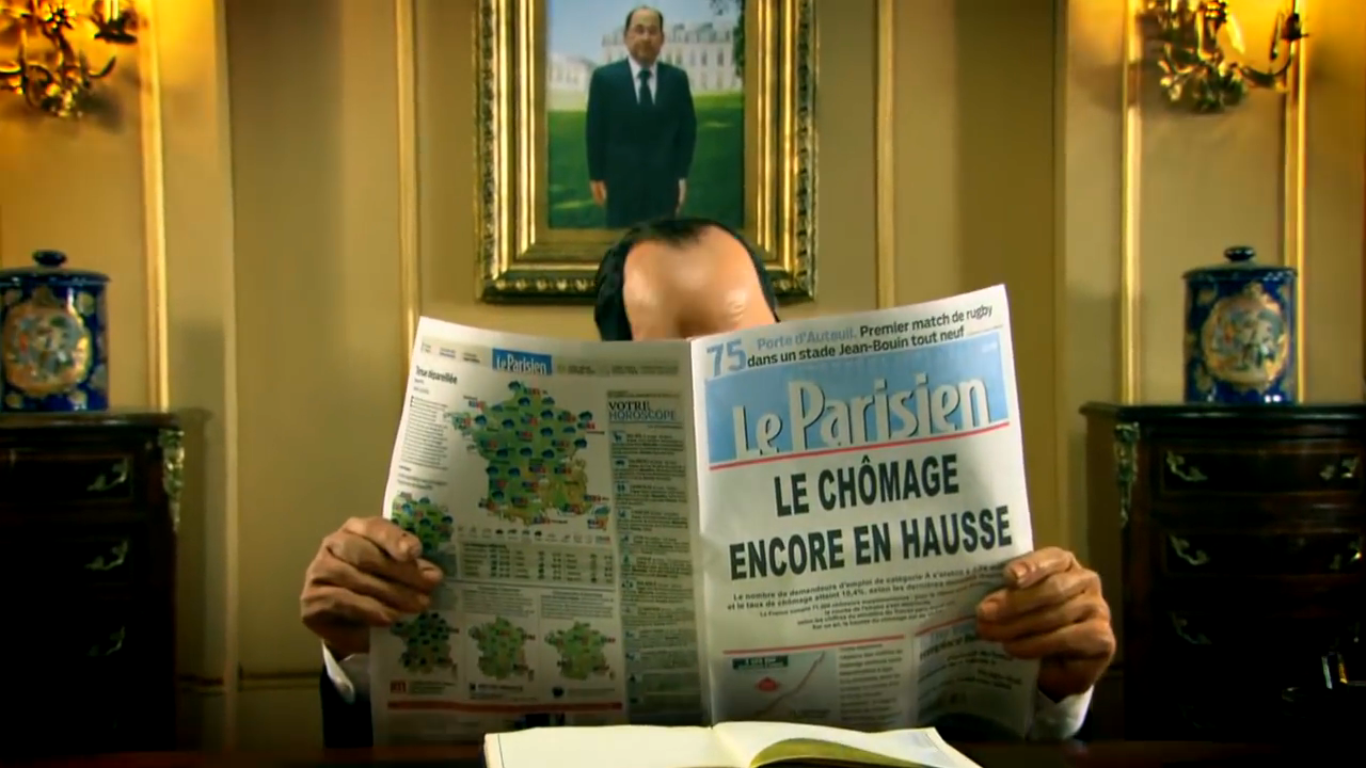
Satirical TV show 'Les Guignols de l'Info' depicts François Hollande reading about growing unemployment. Credit: YouTube
Satirical TV show ‘Les Guignols de l’Info’ depicts François Hollande reading about growing unemployment. Credit: YouTube

Last week saw anaemic growth for the Eurozone as a whole of just +0.3%. For France, the bloc’s second largest economy, it was a humiliating 0 – no growth at all in the second quarter, despite predictions of +0.3%, and a marked fall from the remarkable +0.7% in the months from January to March. Household consumption and business investment and confidence have both slowed, despite measures such as the eurozone-wide programme of quantative easing to stimulate businesses earlier this year.

Ministers will be hoping their big package of measures – the loi Macron – named after economy minister Emmanuelle Macron to liberalise the economy, including Sunday opening hours in tourist areas and cut red tape, will bring more positive figures, but this is still some way off from fruition.

Crucially, the flat-lining of the economy makes any reduction in France’s unemployment rate – currently 10.3% – and its sizeable deficit – due to its immense public sector – all the more difficult.

France is predicting growth of just 1% this year, and 1.6% in 2016, as Finance Minister Michel Sapin remains adamant such growth aspirations can be achieved. Compare that to the UK’s forecast this year of 2.5% growth, and Germany’s 1.7%. Sapin said the government wouldn’t waver from measures such as tax cuts for businesses, which have divided parliament.

France’s economy, along with the rest of Europe, is being buoyed by the 6-year low in the cost of fuel, but this has yet to filter down to weak domestic demand. One analyst says he expects the labour market to gradually stabilise and confidence to be reinforced in the coming months, but added there is little prospect of growth of more than one per-cent this year.

Politics

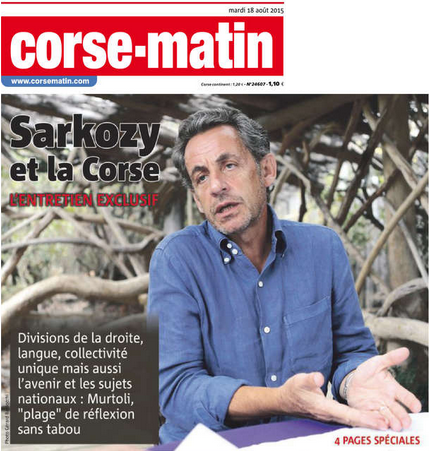
Speaking to a local Corsican newspaper today while on holiday, former President and Republican Party hopeful Nicolas Sarkozy went on the offensive in a strategically explosive interview just a day before politicians return from their break. He criticised Hollande and prime minister Manuel Valls, accusing them of dishonesty. He said: “François Hollande and Manuel Valls have said to us for three years that things are getting better, that unemployment is going to fall, that growth is going to return, that the French people are going to pay less in taxes. Three years that they’ve been wrong or have been lying to the French people.”

An exclusive interview with Nicolas Sarkozy. Credit: Corse Matin
An exclusive interview with Nicolas Sarkozy in Corsica. Credit: Corse Matin

He also took a swipe at Valls’ latest idea of cutting waste and France’s dreaded bureaucracy – to reduce the number of the country’s regions from 22 to 13. He said such a measure “destroys what we have built”. Seeing himself once again as President material, he commented on Russia and France’s pork crisis in Brittany, an ongoing row over unfair pricing for farmers.

It’s worth remembering that France’s delicate recovery matters so much to François Hollande that he has gambled his candidacy for the Socialist party in the 2017 presidential race, affirming that he will step down if unemployment doesn’t fall sufficiently before then. Throughout his presidency, Hollande has consistently punctuated the publication of economic indicators by reiterating the mantra of an economic recovery, but one which is all too weak. It has been clear for some time that many French people have become impatient with this unpopular, repetitive president.

Presidential elections will fall in spring 2017, but the next test for the ruling Socialist government will be regional elections in December, in which Marine Le Pen will likely again make large waves. They will be pivotal in deciding the balance of power and predicting leaders in the 2017 race for the Elysée. Expect many tens of addresses and hours of train journeys crossing the country to talk directly to the French electorate.

At tomorrow’s meeting of ministers, Hollande will be quick to appoint a new Work Minister – a post seen as key in combatting unemployment – as incumbent François Rebsamen leaves the post to focus on his mayorship of Dijon. In the coming weeks, the fight against terrorism and starting to prepare the final budget of the President’s term will be the most important themes.

The environment

If François Hollande can’t cut it for a domestic audience, it will be on the international stage that he will be wishing to gain recognition. Paris will play host to the United Nations Climate Change conference at the beginning of December. François Hollande is hoping for decisive action on the environmental front to be a poignant moment of his quinquennat, or five-year term in office. A legally-binding reduction in greenhouse gas emissions to limit an increase in global temperatures is the key goal of this meeting.

Diplomacy

A month after historical talks between the UN and Iran over its nuclear activities concluded with a deal, and France’s foreign minister Laurent Fabius visit to Tehran, Iranian leader Hassan Rouhani was last month handed an invitation to visit Paris this November. Whilst there is some caution as to the nature of the country’s thawing relationship with the West, what is more assured is the attempt  to restart trade with the isolated Middle Eastern state. François Hollande will be hoping to promote France’s biggest car brands – Renault, Peugeot and Citroen – as Iran’s economy begins the slow process of opening up.

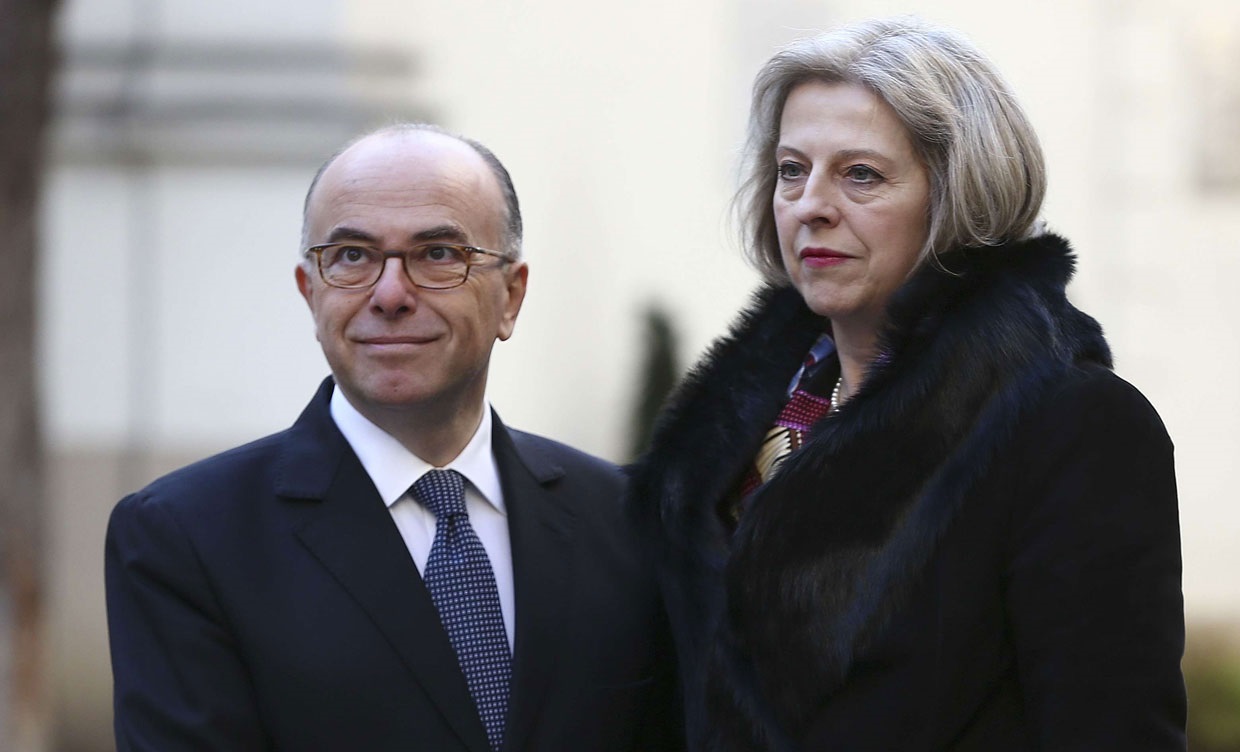
French Interior Minister Bernard Cazeneuve, left, welcomes Britain's Interior Minister Theresa May before the start of an international meeting aimed at fighting terrorism, in Paris, France, Sunday, Jan. 11, 2015. A rally of defiance and sorrow, protected by an unparalleled level of security, on Sunday will honor the 17 victims of three days of bloodshed in Paris that left France on alert for more violence. (AP Photo/Peter Dejong)/PAR115/987867890141/1501111213
French Interior Minister Bernard Cazeneuve meets with British Home Secretary Theresa May in Calais on Thursday

The migrant crisis in Calais has surprisingly received far less mainstream media coverage in France than you would expect. With finger pointing on either side of the Channel, French interior minister Bernard Cazeneuve will meet with his opposite number Teresa May on Thursday, even touring the Eurotunnel, to discuss the migrant crisis, which has seen most recent numbers of migrants dwindle – temporarily or not. A deal will be signed to increase security in the Calais port area, as well as discussing people trafficking and humanitarian efforts.

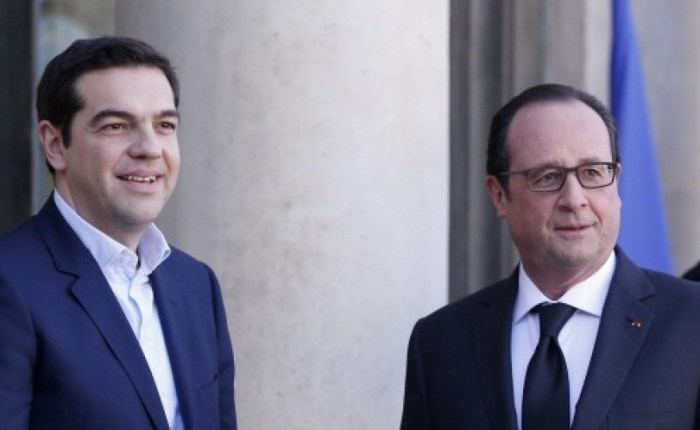
The President’s summer has largely been occupied by the many late-night emergency meetings which brought Greece back from the brink of Grexit and European economic chaos. Negotiating with hardline Angela Merkel and sticking up for Greek PM Alexis Tsipras, Hollande has long been keeping a close eye on European affairs, as he argues for an ever closer currency union between the 19 Eurozone members.

With all of this, there are now only 20 months to the presidential election. One adviser in the Elysée said: “This is a very important phase in the five-year term.”

Mistakes at this point in the political game simply cannot be made.

France’s olive branch to Greece

France’s olive branch to Greece

Greek negotiations are looking more precarious – and harder to predict – than ever. This weekend saw a hard-ball approach from Germany’s finance minister Wolfgang Schäuble, who proposed allowing a temporary exit for Greece from the euro, and an even clearer line from Finland, who rejected the latest proposals, that trust has completely broken down – its finance minister erring more on the side of a Grexit than keeping the country in the single currency. One official said some of the proposals appeared designed to “humiliate” the Greek prime minister Alexis Tsipras and his Syriza government.

Germany stands together with Baltic states, Slovenia, Slovakia and the Netherlands in being uncompromising and more willing than ever before to see the 19-member currency break down. Meanwhile, hope still rests with Southern Europe states such as Spain, Portugal and Italy, who have shown themselves to be far more ready to fight for a deal, owing in part to their own economic troubles. A Greek exit would do them no favours, as the ripples of a broken Europe would flood the entire continent no less.

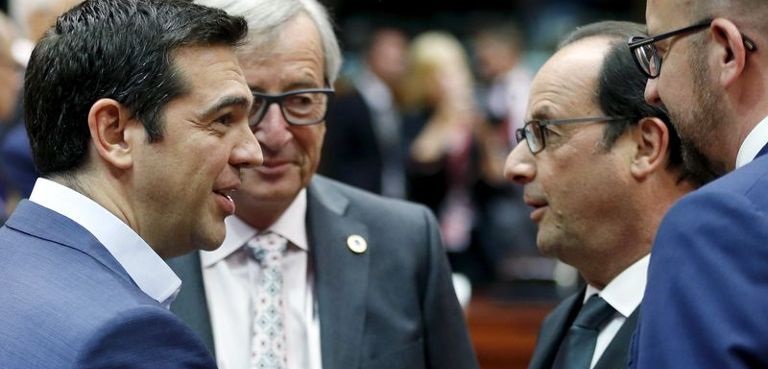
By far the most loyal supporter of Greece throughout the negotiations has been France. Newspaper reports at the beginning of the week outed the fact that advisers from the French Treasury had been in Athens, helping the Greeks to draft out the proposals that prime minister Alexis Tsipras handed to the European Council on Thursday evening. One adviser said: “It’s the Greeks who are holding the pen, but they are using us as a sparring-partner”. Sceptics have used this as a means of exaggerating France’s role, retorting that the Greeks would be incapable of working alone on the list of reforms. Greece needs expertise, and for France, it shows that they are at the very centre of the European game.

greece-s-pm-tsipras-eu

On Sunday, Hollande dismissed German proposals of a temporary Greek exit, which had grabbed many of the headlines. He asserted: “There is no temporary Grexit, there is a Grexit or there is not a Grexit”.

For each French citizen, Greek debt totals 600-700 euros. Although the eurozone has tried since the beginning of this crisis to build a firewall around Greece, a Grexit would nonetheless spell a loss of 55.7bn euros to the French, far more than either Italy or Spain, according to 2012 figures.

France’s president, François Hollande, has long been working hard for a German compromise in achieving a deal, acknowledging the suffering of the Greek people and the need for “indispensible” reforms. On Wednesday, he said Greece’s latest proposals for its next 59bn euro bailout were both “serious” and “credible”. Hollande equally talked of the need of a united Europe, whose break-up Angela Merkel could realistically never allow herself to preside over.

The Greek crisis has marked the fracturing of the symbolic, long-standing Franco-German micro-managing of the European Union’s recent troubles – Angela Merkel seems more than ever to run the show alone – her calm, measured approach resonating far more than any other leader.

In no uncertain terms, France’s economy minister, Emmanuel Macron, warned in Spain’s El País newspaper on Thursday: “if we don’t act fast, the euro zone will cease to exist in ten years”. In what is increasingly seen as a disagreement around negotiation tables, Macron argued that a Grexit would not only be an economic failure, but political. He said: “Not doing everything possible so that Greece stays in the eurozone is accepting a deterioration of Europe”. Macron’s grand gestures were accompanied by a warning for the 19-member currency as a whole: “the status quo and ambiguity are driving us to the disbanding of the eurozone.”

Echoing the language of Hollande, he said a compromise had to be found, with ambitious reforms for Greece, but not so much so that they destroy the country’s economy, given its already painful course of austerity. Investment was needed for growth, but Macron maintained a critical line against Syriza and Tsipras, who is no hero of the Greek people, he said.

François Hollande has always been seen to be more presidential on an international stage, from France’s military intervention into former colony Mali’s war against Islamists, to the British co-ordinated attack on Libya. In reality, he is continuing to struggle with his own domestic politics – a weaker-than-expected economic recovery, with unemployment refusing to budge. Economic growth for this year is predicted at 1.2%, admittedly far more than the 0.4% average growth of the past three years.

A strong Europe can not only afford Hollande a more statesman-like appearance on the continental stage, more crucially it pays to counter the anti-EU rhetoric of Marine Le Pen’s Front National party, whose reaction to Greece’s ‘no’ vote was to laud Greek PM Alexis Tsipras as a respected leader and a man of the people. She was clearly drawing on the rhetoric of increasingly potent populist politics sweeping across Europe. To draw parallels, Le Pen conjured up the figures of Mitterand, even de Gaulle, to colour her complimentary remarks. At the same time, she attacked Hollande for being the “cabinet director of Jean-Claude Juncker”.

Le Pen talked of the victory of the ‘no’ camp as a means of standing up to the “oligarchy” of the EU, the “diktats” of the single currency and an “inhumane” austerity. In short, she said: “this No is excellent news”, spelling the end of France throwing money into Greece’s black hole of debt. She even coined the term “eurosterity” (or eurostérité), calling for the dissolution of the single currency, which she likened to a vanity project which was saving face only by imposing tough austerity.

Running short of allies, Alexis Tsipras cut a lonely figure around the negotiation table on Sunday. As leaders enter a new week of talks, nobody really knows whether Greece is blindly tip-toeing to the exit door, or if the solidarity shown by the likes of France will ultimately lead to a last-minute deal. After leaders ignored the seemingly apocalyptic Sunday deadline, the can-kicking that has characterised negotiations looks set to continue, for how ever long it can.

French education reform

French education reform

I’ve been avidly following the twists and turns of the biggest story in France for a few weeks now – the controversial education reform that the Socialist government is wishing to bring into force despite protests and a lot of noise from the unions and the right of politics. It’s a heady mix of education and politics, and it rarely goes smoothly.

Here is my 2-minute report on what has been happening this week with this big debate in France.